
- October 9, 2026
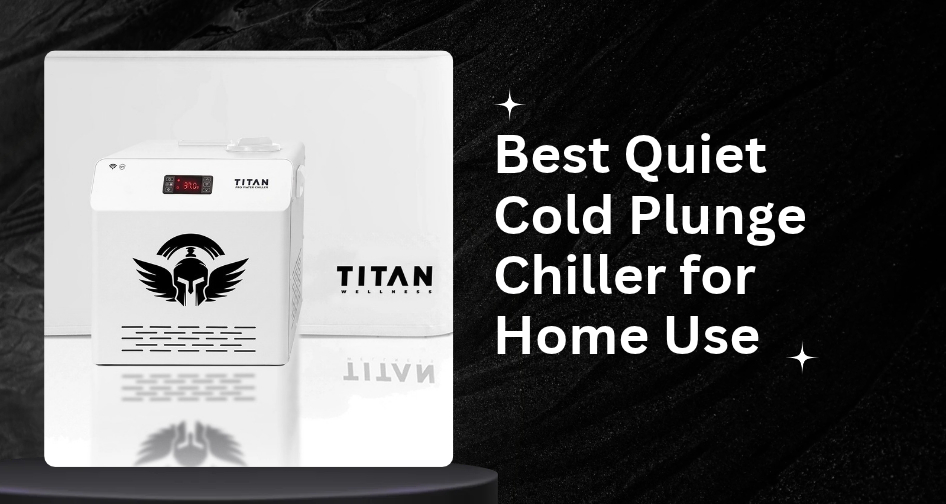
The Titan 1/3 HP Universal Cold Plunge Chiller is the quietest unit in the Titan Gen V line, rated at 40–45 dB about 3 feet away. For most homes, it is the best quiet cold plunge chiller, as long as the tub is small enough for it to reach the set temperature.
However, noise depends on three things: unit size, distance from the chiller, and run time. A unit that is too small runs for hours and gets noticed. A unit that is too large is louder every minute it runs. The sections below show how to match a quiet cold plunge chiller for home to the tub, the climate and the space.
What counts as a quiet cold plunge chiller?
A quiet chiller stays near the level of normal indoor background sound. The CDC lists normal conversation at 60 dB. The EPA names 45 dB indoors as the level that avoids annoyance and activity interference. That figure is a guideline, not a law. Buyers can judge any quiet cold plunge chiller against these two marks.
| Sound | Level |
| Whisper | 30 dB |
| EPA indoor comfort goal | 45 dB |
| Normal conversation | 60 dB |
One more rule matters. A chiller noise level means little without a distance. In open space, sound drops about 6 dB each time the distance doubles. A reading at 3 feet will differ from one at 10 feet. Buyers should look for the cold plunge chiller dB at 3 feet, or ask which distance was used. Rooms with hard walls bounce sound back, so real drops are smaller.
How loud are cold plunge chillers by size?
Chiller noise rises with cooling power. Titan’s published figures, measured about 3 feet away, run from 40–45 dB for the 1/3 HP to 50–55 dB for the 1/2 HP and 50–60 dB for the 1 HP.
That range answers how loud a cold plunge chiller is. The 1/3 HP sits at or just under the EPA’s 45 dB indoor goal, so it blends into a quiet room. The 1/2 HP and 1 HP are closer to normal conversation, which the CDC places at about 60 dB.
| Model | Noise at ~3 ft | Cooling power | Cooling time per 100 gal | Best climate | Daily use |
| Titan 1/3 HP Universal Cold Plunge Chiller | 40–45 dB | 815 W | 4–6 hours | Below 85°F | 3–5 kWh |
| Titan 1/2 HP Universal Cold Plunge Chiller | 50–55 dB | 1,141 W | 2–4 hours | Above 85°F | 5–7 kWh |
| Titan 1 HP Universal Cold Plunge Chiller | 50–60 dB | 2,600 W | 1–2 hours | Above 100°F | 7–10 kWh |
All three are Wi-Fi/app-controlled chillers with UV sanitation, a sediment filter and a 20-micron filter. They plug into a standard 110 V outlet. Each works as a water chiller for cold plunge tubs, including an inflatable tub chiller setup, and each can also serve as an ice bath chiller for a standard bathtub with a drop-in connection.
Which chiller size stays quietest in a real home?
The correctly sized unit stays quietest overall. An undersized chiller runs for longer stretches, and longer running means more hours of noise. Titan’s sizing guidance makes the same point. So what size cold plunge chiller do I need? Start with tub volume and local climate. Read the full guide on what size chiller a cold plunge needs for detail.
| Tub water | Cool climate (below 75°F) | Moderate (75–85°F) | Hot (85°F+) |
| Up to 100 gal | 1/3–1/2 HP | 1/3 HP | 1/2 HP |
| 100–140 gal | 1/2 HP | 1/2–1 HP | 1 HP |
| 140–180 gal | 1/2–1 HP | 1 HP | 1 HP |
A 1/3 HP chiller for a 100-gallon tub works well in a moderate climate. In summer heat, a cold plunge chiller for hot climate use needs more capacity, and the 1 HP is rated for conditions above 100°F. Cooling power is not only horsepower, so see HP vs. BTU cooling capacity. Buyers with larger tubs can compare the 1 HP cold plunge chiller. Does a 1 HP sound like an air conditioner? Titan compares its noise to a household air conditioner or a quiet conversation.
Where should a chiller go to keep it quiet?
Placement can lower perceived noise more than a smaller motor can. In open space, a 1/3 HP unit at 40–45 dB at 3 feet would read about 34–39 dB at 6 feet and 28–33 dB at 12 feet. These are best-case estimates, because walls add sound back.
- Quiet cold plunge chiller for garage use: set the unit on a vibration-absorbing pad. Titan advises placing it slightly away from seating or sleeping areas.
- Quiet chiller for apartment cold plunge setups: avoid shared walls and leave open space for airflow.
- Bedroom next door: distance and a closed door help most.
- Heat: shade protects the unit, and Titan advises avoiding direct sunlight.
Can I use a cold plunge chiller indoors? Yes. Titan rates its chillers for indoor and outdoor use. Indoor spaces need ventilation and a GFCI-protected outlet. For more, see indoor vs. outdoor cold plunge setup.
Can app scheduling make a chiller less noticeable?
Yes. Scheduling moves the loudest phase of cooling to hours when no one is home. The first pull-down from tap-warm water takes the longest. At 4–6 hours per 100 gallons for the 1/3 HP, it can finish before the first morning session. Does it run all night? Only if scheduled that way. A Wi-Fi chiller lets owners set the start time and target temperature from a phone. After pull-down, the unit cycles on and off to hold the set point instead of running nonstop.
Some owners say it’s the pump, not the compressor, that they notice first. That’s why it’s smart to ask where the pump sits. With Titan Gen V, there’s nothing to place. Two pumps are already built into the chiller body.
How much does a quiet chiller cost to run?
Running cost equals kWh per day times the local rate. The US Energy Information Administration puts the 2026 residential average near 18.2 cents per kWh. At that rate, Titan’s published daily usage works out as follows. Cold plunge chiller electricity cost shifts with the state rate, so buyers should check their own bill.
| Model | Daily use (Titan) | Approx. daily cost at 18.2¢/kWh |
| 1/3 HP | 3–5 kWh | $0.55–$0.91 |
| 1/2 HP | 5–7 kWh | 0.91–1.27 |
| 1 HP | 7–10 kWh | $1.27–$1.82 |
A similar question arises many times, and that’s, ‘Is a chiller better than ice for a cold plunge? For regular users, often yes. Titan estimates 15–40 lb of ice per session at about $3 per 10 lb. It says a chiller repays its cost in 3–4 months at five sessions a week. See what it costs to run a cold plunge chiller and cold plunge chiller vs. ice.
Who should talk to a doctor before cold plunging?
Cold water hits the body fast. The American Heart Association describes cold shock as a sudden rise in breathing, heart rate and blood pressure. That’s why anyone with a heart condition, high blood pressure or circulation problems should check with a doctor first.
A UVM Health cardiologist advises that people with established heart disease, or at risk of a heart attack, should not do it. Beginners can start near 55–60°F for about one minute, as Titan suggests, and build up slowly. A cold plunge routine at home works best when it starts gently.
Which quiet cold plunge chiller should a home buyer pick?
The best quiet cold plunge chiller for home use is the smallest unit that still holds the set temperature. For small and medium tubs in moderate climates, that points to the Titan 1/3 HP, rated at 40–45 dB about 3 feet away. Bigger tubs and hotter climates call for the 1/2 HP or 1 HP. Those are easier to hear, so they sit best in a garage or on a patio.
Two habits keep any chiller quieter. Place it away from sleeping areas, and schedule the first cooldown overnight in the app. Buyers can also ask any brand for its dB figure at 3 feet before ordering.
Ready to compare sizes? Browse the Titan water chillers collection, or start with the Titan 1/3 HP Universal Cold Plunge Chiller, the quietest unit in the line.
Frequently asked questions
Can a 1 HP chiller sit in a garage?
Yes. A garage handles the 50–60 dB range far better than a living space, since walls and distance soften the sound. Placing the unit on a rubber pad and leaving clearance around its vents helps airflow and keeps vibration down.
Does a Titan chiller work with an existing tub?
Usually, yes. Titan states its chillers fit most third-party tubs with standard fittings, and a drop-in setup works for bathtubs. Buyers should compare the tub’s connector size with the chiller’s requirements before ordering, so nothing needs adapting later.
How long does cooling take?
A smaller chiller cools more slowly. Titan lists 4–6 hours per 100 gallons for the 1/3 HP, 2–4 for the 1/2 HP and 1–2 for the 1 HP. For the first cooldown, an overnight app schedule hides the wait.
Which model should most buyers choose?
Small or medium tubs in climates under 85°F match the 1/3 HP. Above 85°F or with a larger tub, the 1/2 HP fits better. The 1 HP covers heat above 100°F. All three are in the Titan water chillers collection.
Recent Blogs
Best Quiet Cold Plunge Chiller for Home Use (2026 Guide)
October 9, 2026
The Titan 1/3 HP Universal Cold Plunge Chiller is the quietest unit in the Titan Gen V line, rated at 40–45 dB about 3 feet away. For most homes, it is the best quiet cold plunge chiller, as long as the tub is small enough for it to reach the set temperature. However, noise depends on three things: unit size,
Read More